


Why is the Karnak Temple so famous?
Table of Contents
-
Introduction
-
Who is the god of the Karnak Temple?
-
What is the history of the Karnak Temple?
-
What is the layout of the Karnak Temple complex?
-
Is there a mystery of the Temple of Karnak?
-
Is Karnak the biggest temple in the world?
-
Conclusion
Introduction
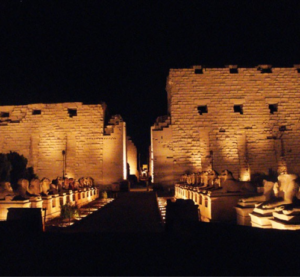
The Karnak Temple is the largest religious complex constructed in Egypt and is believed to be the second-most visited site after the Great Pyramids in Egypt. It also includes an open-air museum situated 3 km north of modern Luxor. It is unique because it was constructed during the Middle Kingdom, the Ptolemaic age in Egypt.
In 1979, it got recognized as a UNESCO heritage site in the monumental city of Thebes (modern-day Luxor). The temple is primarily dedicated to the sun god; over 30 pharaohs have seen it. The whole complex is seen as one of the sacred monuments in Luxor. It is also recognized as the worshipping place for the Theban triad, an Egyptian set of gods usually worshipped by the 18th dynasty.
In this travel blog, you will learn about the insights of the Karnak complex and why it’s a famous location among tourists around the world and why travel companies like Swan Dahabiya have included it in the list of ports of call. There are several reasons that make it a hotspot tourist location.
A major shore excursion in the Luxury Dahabiya Nile Cruise itineraries. Guided tours by the cruising companies make it a prime historical marvel for exploration purposes.
Secondly, its architecture and unique Ptolemaic age marks make it fascinating for tourists. Major points about the temple are presented below in question-and-answer form for easy understanding of the readers.
Who is the god of the Karnak Temple?
The Karnak temple complex is a holy worship place dedicated to three major gods: Amun, Mut, and Khonsu. Also commonly known as the Theban triad, these are three divine bodies of a family that is responsible for creation, kingship, fertility, and cosmic stability, making the Karnak Temple an important place in Upper Egypt.
Amun: He is considered the king of the gods, who is also seen as a local god of Thebes. This god is also associated with the kingship and creation.
Mut: The great mother goddess and wife of god Amun, signifies the motherly role and protection. This god is associated with queenship and femininity.
Khonsu: Widely known and worshipped as the moon god, he is the son of Amun and Mut. This god is seen as the moon, time, healing, and fertility. People worship him for his good health.
What is the history of the Karnak Temple?
The city of Thebes (current-day Luxor) was not much developed before the eleventh century. During the Amun, a god widespread in the eighteenth century, the major developments in the city of Thebes took place. Then, after it becomes a major cultural center, it is also chosen as the capital of the Upper Egypt region.
What is the layout of the Karnak Temple complex?
The layout of the Karnak Temple is unique and consists of the Great Hypostyle Hall, the Avenue of Sphinxes, the sacred lake, and the obelisk of Hatshepsut, which has a link with the unfinished obelisk in Aswan.
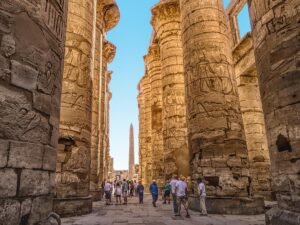
From all the major parts, the hypostyle hall is unique and a major spot that is largely explored by travellers reached by Nile River cruise dahabiya. It is so long and vast that it captures the attention of the tourists; many travellers have pictures clicked in the Hypostyle Hall that you can see upon searching about them. Here is the list of architectural facts that make it a center of attraction in the complete Karnak Temple complex.
- It is the precinct (mansion or personal space of the god) of Amun, the king of gods.
- Constructed on 1.2 acres.
- The space has over 134 large columns that are perfectly aligned in 16 rows.
- 120 of these columns are 10 meters.
- And the other 12 and 21 have a diameter of around 3 meters.
- On top of the columns are architraves, usually seen on the top of Egyptian columns in many historical monuments.
- Each has a weight of around 70 tons.
Is there a mystery of the Temple of Karnak?
Yes, the mystery around the Karnak Temple is associated with its massive architecture and large-scale construction during ancient times.
- Karnak was built on such a massive scale—how is it possible?
- The perfect alignment with the cosmos, the celestial accuracy, makes it a mystery how people of that age had such great knowledge of astronomy.
- The Hidden Symbolism in Its Design, showing the universe’s creation with the water lake and hypostyle halls.
- The power and wealth of Amun’s era and the great construction also unlock the mystery of how much of a god Amun is and why he is so powerful.
- Erased Names and Altered History holds mysteries about several attempts taken by the invaders and other pharaohs later on.
Is Karnak the biggest temple in the world?
No, the Karnak Temple in Thebes (present-day Luxor, Egypt) is not the largest temple. There are other monuments like Cambodia’s temples, which hold the status of the largest temple in the world. In ancient Egyptian history, the Karnak complex is the largest religious construction that the present day has. It is a major spot for the Dahabiya Nile cruise passengers as they explore the east and west banks of Luxor.
Conclusion
If you have ever been to Egypt, you must know the greatness of Karnak Temple. If you have yet to explore it, then as an experienced cruising company, we suggest you take Nile cruises or book a small luxury Nile cruise in Egypt to reach Luxor. In this way, you can explore the ancient marvels and serene nature landscapes while on a soulful sailing journey on the River Nile.
Other Useful Links: