


Karnak Temple Complex
The Karnak temple complex, situated on the east bank of Luxor, is one of Egypt’s top historical monuments. The different thing about this monument is that it’s not a single temple; the Karnak complex consists of temples, chapels, pylons, and halls that are situated on a vast part of land. This particular monument carries the legacy of different dynasties that narrate the stories of different pharaohs.
During the Dahabiya Nile Cruise in Egypt, travelers have a stop on the east bank of Luxor; here they explore the majestic Karnak Temple complex and its features, roaring with history at Hypostyle Hall, pylons, and wall carvings. The monument is among the largest religious places on the list of ancient Egyptian wonders.
Karnak Temple at a Glance
| Details | Information Regarding Karnak Temple (Luxor) |
|---|---|
| Location | East Bank of Luxor |
| Ancient Name | Ipet-isut (meaning: “The Most Selected of Places”) |
| Construction | Developed over multiple dynasties |
| Major Contributors | More than 30 Pharohs |
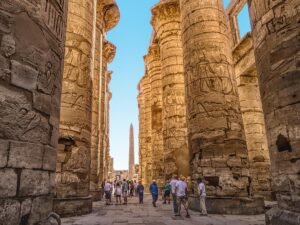
| Great Hypostyle Hall | 134 massive columns |
| Typical visit duration required | Around 2-3 hours |
| Best visiting hours | Early morning or late afternoon |
| Photography | Flash photography is not allowed. |
What is the Karnak meaning?
The word “Karnak” originated from the Arabic word “El-Karnak.” It stands for “Fortified Village” in modern language. The temple in Karnak was built over a long time span, so Egyptians in older times recognized it as Ipet-Isut, which means in the modern world “the most select of places.” These names depict that Thebes (modern-day Luxor) was a hotspot location for early civilization to live and work.
To date, Luxor is one of the major ports situated on the banks of the Nile River. Aswan and Luxor are the ones between them where the Swan Dahabiya sails its cruises, as these routes have a history intact between the two ports. In these shore excursions, Karnak Temple’s light and sound show becomes the talk of the vacation; you will also get insight into it on this page.
Let’s learn a little about the Karnak Temple Complex in Egypt.
When was Karnak Temple built?
The construction of the temple started in 1971 BCE under the regime of Senusret I during the Middle Kingdom era. Karnak was not built as a single project; its construction and expansion continued and took place during the New Kingdom in and around 1070 BCE, with more than 30 pharaohs contributing to the complex. Major pharaohs that have contributed to its construction are Hatshepsut, Thutmose III, Seti I, and Ramses II, and different ruling times in their dynasties. These additions by new kingdom rulers reflect that Thebes was an important religious and political center. This long period of development explains why Karnak contains such a varied collection of pylons, halls, sanctuaries, obelisks, and religious spaces.
What is the Temple of Amun-Re?
The Karnak temple complex is also known as one of the Amun-Re temples. The gods in ancient Egypt are closely related to the pharaohs, and they believed that they were ruled by supreme powers. So, Amun-Re, a prominent god in ancient Egyptian scriptures, is seen as the king of gods, and Karnak was closely associated with the Theban Triad of Amun, Mut, and Khonsu; here, Amun was regarded as the chief deity of the triad and was depicted as the king of kingship and creation. Mut is regarded as Amun’s consort, representing motherhood and protection, while the son Khonsu was associated with the moon, time, and healing. Together, the three deities found an important part of the religious traditions of ancient Thebes.
Key features of the temple complex, like the Great Hypostyle Hall with 134 massive columns, the Sacred Lake used for purification rituals, and obelisks, including one of Queen Hatshepsut’s Obelisk, which still stands at Karnak and is described as the second-tallest standing obelisk in the world, making it one of the most recognizable surviving monuments within the complex. Also, there are major areas that reflect the religious value of Amun-re. The temple of the Karnak complex has served as a major religious center for auspicious occasions, and it also symbolizes the divine power and authority of the pharaoh.
Learn:- Why is the Karnak Temple so famous?
Karnak temple map
The complex is widely spread over an area of 200 acres; it consists of three main precincts.
- Precinct of Amun-Re (largest and central)
- Precinct of Mut
- Precinct of Montu
The main axis of the temple has a perfect alignment with the longest flowing river, the Nile. The north-south axis connects the Karnak temple complex with the major Luxor temple. Then the avenue of Sphinx served as the ceremonial pathway; all these architectural factors depict the excellent knowledge and experience of experts. One thing about the Egyptians that attracts tourists and researchers is the unique and complex architecture of these historical monuments.
Temple of Karnak facts
- It is amongst the largest religious building complexes in the city of Thebes in ancient Egypt ever constructed; pharaohs from three dynasties have completed it.
- Some stone blocks weigh over 100 tons, which were used in the construction of the massive Karnak complex. The lifting of these heavy weights is still a secret and a debatable subject of Egyptian archeology.
- The walls of the complex are covered with hieroglyphs showing rituals and victories; it is like history itself narrating the rich cultural heritage of ancient civilizations.
- Built by multiple rulers rather than a single pharaoh, this one thing makes it unique from other monuments in Egypt.
- Considered an open-air museum of ancient Egyptian history, as carvings and a hypostyle hall with 134 columns show its greatness to explorers.
- More than 30 pharoahs contributed to the construction and expansion of Karnak over different periods, making it a monument shaped by multiple rulers rather than a single pharaoh.
- The complex developed over roughly 1,500 years, with major additions made during different dynasties.
- The Avenue of Sphinxes connected Karnak with Luxor Temple and was lined with approximately 1,057-1,059 statues, including sphinxes and ram-headed sphinxes.
- The complex covers an estimated 247 acres of area at the East Bank of the Luxor.
- Karnak contains sacred lakes, statues, chapels, and smaller sanctuaries, reflecting its importance as a major religious center.
- The Roman emperor Constantius II ordered the closure of pagan temples around 356 AD, after which parts of Karnak were adapted or fell into decline.
- The Thebes and its associated monuments were inscribed as a UNESCO World Heritage Site in 1979.
- The Karnark temple was carefully aligned with the sun and the cosmos, reflecting that people of that age had such great knowledge of astronomy.
- Karnak grew as Amun became one of Egypt’s most important gods, which reflects the rise of the religious, political, and economic importance of Amun and his priesthood during Theban and New Kingdom history.
- The surviving traces of erased names and images, particularly those associated with Hatshepsut, show how later rulers altered earlier monuments and historical narratives.
- The size of Karnak shows the great power and wealth of ancient Egyptian rulers.
The Karnak temple sound and light show
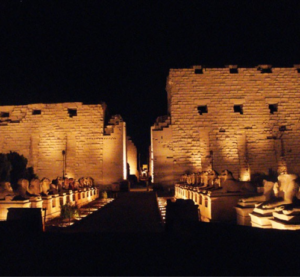
The light and sound show at Karnak Temple is something that travelers should not miss. It provides a memorable experience and creates a magical canvas with lights that makes history speak. By witnessing it, you will feel like you have traveled back in time. Some points that explorers should know about are mentioned below.
- The winter and summer timings vary, but mostly the show happens around 07:00 pm to 08:15 pm.
- The language of the light & sound show varies; the shows happen in English, French, German, and Arabic.
- The night light & sound shows are mostly counted as exclusions in the cruising packages, so visitors have to buy separate tickets for the show.
- In this show, the story of Thebes (modern-day Luxor) is narrated through projections on the walls of the temple.
Plan Your Visit to Karnak Temple in Luxor
Karnak is a large temple complex, so exploring it involves considerable walking between its halls, pylons, sanctuaries, and open spaces, so planning a little can make the visit more comfortable, particularly during Egypt’s hotter months.
Follow these practical tips for an effortless visit to the temple.
Wear comfortable walking shoes: Choose supportive walking shoes rather than fashion footwear, as the complex covers a large area, and exploring the Great Hypostyle Hall, courtyards, and sanctuaries involves extended periods on foot.
Carry water and sun protection: Bring a water bottle, sunglasses or a hat, and sunscreen. Shade can be limited in some of the open areas of the complex, particularly around the middle of the day.
Avoid flash photography: You can bring your camera or smartphone to photograph the architecture and carvings, but the flash photography is not permitted according to the existing guide.
Choose your visiting hours carefully: For more comfortable sightseeing, early morning or late afternoon is preferable. From October to April, daytime temperatures are generally more comfortable. During summer, consider visiting before noon or after 4 PM to avoid the strongest daytime heat.
Allow enough time: A guided visit generally takes around 2–3 hours, although travelers interested in the history, inscriptions, and architecture may want longer.
Consider exploring with a guide: Because Karnak contains several temples, halls, chapels, pylons, and sanctuaries, a knowledgeable guide or Egyptologist can help explain what you are seeing rather than leaving the architectural details without context.
Commonly Asked Questions
Can visitors see the map of Karnak Temple?
Yes, the drawing-scale image of the Karnak Temple map is available at the entrance of the monument and can also be found online. The maps of the temple help explorers understand the layout of the monument; most of the tour guides include detailed explanations of the maps.
What is the Avenue of Sphinxes?
It is a 2.7 km-long ceremonial road that connects the Karnak Temple to the Luxor Temple. It is used during major religious festivals like the Opet Festival.
What is the Great Hypostyle Hall?
The great Hypostyle Hall is one of Karnak’s most remarkable architectural spaces, covering approximately 1.2 acres. The hall contains 134 massive columns, which are arranged in around 16 rows. Also, the twelve central columns rise to around 20 meters, while the remaining columns are shorter, creating the distinctive forest-like appearance of the hall. Some of the enormous architectural elements are estimated to weigh around 70 tons, which also illustrates the extraordinary scale of ancient Egyptian construction.
How long does it take to explore Karnak Temple?
The average time for a guided tour is around 2 to 3 hours. Travelers with a keen interest in knowing in-depth about historical monuments may take a little more time. Tours with travel guides usually end in 2 hours.
Why is October to April the best time to visit Egypt?
Well, the answer to this question is simple: the weather. Summers in Egypt, from May to September, are extremely hot, so travelling from October to April in winter offers easy day explorations, and travelers can also witness the pleasurable feel of dahabiya cruises on the Nile as well.
Why is the Karnak Temple so famous?
The Karnak is famous for its extraordinary scale, religious importance, and architectural complexity. Unlike a monument built by a single ruler, the complex was developed and expanded by numerous pharaohs over many centuries. Its highlights include the Great Hypostyle Hall with 134 columns, the Avenue of Sphinxes, Hatshepsut’s obelisk, sacred spaces dedicated to the Theban gods, and extensive hieroglyphic reliefs, and also its association with Amun and the religious traditions of ancient Thebes further adds to its historical importance.
Is Karnak the biggest temple in the world?
No. Karnak is not considered the largest temple in the world. However, it is one of the largest and most significant religious complexes of ancient Egypt. Its enormous scale comes from centuries of construction and expansion by different rulers, rather than from a single building project. The complex includes multiple temples, pylons, halls, chapels, sanctuaries, and sacred spaces, with the Great Hypostyle Hall being one of its most famous architectural features.