


Mortuary temple of Hatshepsut
Egypt’s other ancient marvels include the stunning Mortuary Temple of Hatshepsut, a strong female pharaoh in Egyptian history, who ruled with authority and survived strongly in a male-dominated early civilization world.
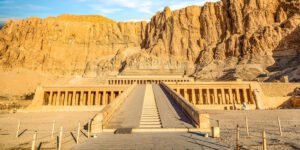
Where is the mortuary temple of Hatshepsut?
On the west banks of the river, Dier el-Bahari has kept the secret of Hatshepsut preserved for years. In Luxor the temple of Hatshepsut is located and serves as one of the historical monuments from the pharaoh age in Egypt.
This location is one of the top shore excursions while on the Swan Dahabiya Nile cruises. Passengers on the Luxury Dahabiya Nile Cruise explore the wonders of ancient architecture covered with cliffs, making the site look like an excellent example of the rich cultural heritage of the ancient Egyptian people.
In this part let’s explore the temple of Hatshepsut, and we are sure that you will get answers to your queries about Hatshepsut and its significance during the age of pharaohs in Egypt.
What is the Temple of Hatshepsut?
The temple is officially known as Djeser-Djeseru, meaning “Holy of Holies,” reflecting its sacred purpose. It was built as a place where the human forms (pharaohs) could connect with the eternal powers (gods), especially Amun-Ra. The structure represents Hatshepsut’s divine right to rule, showing her not just as a queen but as a chosen leader.
Learn More:- Why is the Temple of Hatshepsut so important?
Mortuary Temple of Hatshepsut Facts
- The temple symbolized the idea of rebirth and eternal life, which was central to Egyptian belief.
- Its alignment with the cliffs shows the belief that nature and divinity were connected.
- Long terraces represent the journey from the earthly world toward the spiritual realm.
- It served as a memorial to Hatshepsut’s legacy, ensuring her name would live forever and coming generations would know about her.
- More than a tomb, the temple’s meaning lies in power, identity, devotion, and remembrance of the greatness of Hatshepsut.
Its Significance
It is one of the earliest examples of grand symmetrical architecture of the pharaoh age. The temple proves that women could rule with authority and intelligence in ancient Egypt, and also it highlights the importance of religion in political power, as Hatshepsut linked herself closely with the god Amun. The mortuary temple of Hatshepsut photos also prove that some monuments do just stand but carry the message and legacy from centuries to the present generation.
The carvings provide valuable historical records, especially about trade, diplomacy, and royal achievements. This is the only ancient architectural marvel that was tried to be destroyed by its own successor despite its having helped historians understand the art, engineering, belief systems, and leadership of the New Kingdom through centuries.
History & inside of the Hatshepsut temple
Over centuries, natural disasters and neglect caused parts of the temple some damage, and then during the 19th and 20th centuries, archaeologists began serious excavation and restoration work. Today, the temple stands as a rebuilt and preserved monument, telling a story of both glory and survival.
Who built the mortuary temple of Hatshepsut?
The temple was built around the 15th century BCE during the reign of Queen Hatshepsut and was designed by her trusted architect, Senenmut, the vizier, who played a key role in its planning. Construction took many years and involved skilled workers carving terraces directly into rock. After Hatshepsut’s death, her successor, Thutmose III, attempted to erase her legacy by damaging her images.
How is the temple presented for the visitors?
The temple is now a carefully protected archaeological site by the tourism department of Egypt. Several sections have been restored using original materials and techniques to make it an open museum for the world to see the authoritativeness of the female pharaoh from the ancient Egyptian age. Visitors can walk along the three grand terraces connected by ramps; there they can see the faded carvings that prove destruction and how the monument has survived all these years.
Security and conservation teams work daily to prevent damage from tourism and weather. Also, the information boards and guided tours help visitors understand the history better. It is advised that the travelers only visit with a tour guide for better understanding of the history and significance, as they can narrate the untold stories, which may not be available on the information boards.
What Makes the Temple a Major Tourism Spot?
Its unique terrace-style architecture is unlike any other temple in Egypt, and the dramatic setting against limestone cliffs makes it visually breathtaking. Tourists get fascinated by the story of Egypt’s powerful female pharaoh.
It is located close to other attractions like the Valley of the Kings, making it easy to include in tours. Photographers and travelers visit for the perfect blend of history and natural beauty, and educational groups use the site to learn about gender, power, architecture, and culture, as it offers a deeper emotional experience because it tells a human story of ambition, resistance, and legacy.
Faqs
Can tourists visit the Temple of Hatshepsut today?
Yes, the temple is open to visitors and is one of Luxor’s most popular historical sites among the river cruising passengers. The walkways, guides, and preservation efforts allow people to explore it safely while protecting its ancient features.
How much time should I plan to spend at the temple?
In general, a guided tour for visitors takes about 45 minutes to 1.5 hours exploring the terraces, taking photos, and reading about the history. If you enjoy photography or detailed exploration, you may want to stay longer.
Can I take photographs inside the temple?
Photography is allowed in most areas of the temple that are open for visitors. However, flash photography is discouraged because it can damage the ancient carvings over time.
What are the visiting hours of the Hatshepsut temple visit?
The mortuary temple of Hatshepsut is open all seven days. Tourists can visit anytime from 6AM to 5PM. Better explored in the early morning, as during the day the sun may make your exploring a little hectic.
Why is carrying water advised while on site exploration?
In Egypt, the exploring demands long walks, which can make you feel tired or exhausted. The dry weather can affect your health, so it is advised to stay hydrated so travelers can explore the historical sites without feeling any discomfort.