


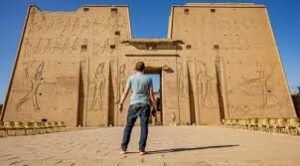
In the list of ancient Egyptian monuments, the temple of Edfu is also one of the best-preserved monuments to date. It is a monument built between 237 BCE and 57 BCE, long after the age of pyramids, mostly during the Middle Kingdom. The construction of the temple was begun in 237 BCE during the reign of Ptolemy III Euergetes and was completed in 57 BCE under the reign of Ptolemy XII Auletes. The entrance of the temple is something that makes it unique from other temples; from the detailings to the hieroglyphs, everything is carved so precisely, which also makes it a hotspot location for travelers to visit every year while on their tour to Egypt.
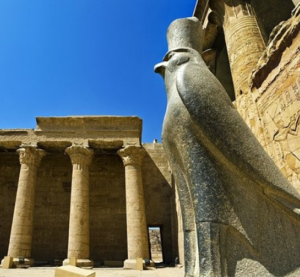
This temple also has the sacred statue of the falcon-headed god, Horus, a prominent god in the Egyptian scriptures often seen as a symbol of protection, goodness, and kingship. The temple also symbolizes the famous story of Horus and Seth, which depicts the victory of good over evil.
The sacred temple in Edfu has valuable carvings that depict ancient Egypt’s religion, culture, languages, and daily life. Its size, structure, and architectural prospects make it the perfect classical Egyptian temple design, and as it is well-preserved, it is also beneficial for explorers to understand the ancient monumental architecture better.
Where is the temple of Edfu located in Egypt?
The Temple of Edfu is situated in the town of Edfu in Upper Egypt, positioned along the west bank of the River Nile. Its location between Luxor and Aswan made it an important religious stop for travelers and pilgrims in ancient times, as stated in the research while translating the hieroglyphic language.
The surrounding area is mainly desert landscape, with fertile green fields appearing closer to the Nile, as the temple was built slightly above the floodplain level, protecting it from seasonal Nile flooding. Edfu’s climate is hot and dry, which has helped preserve the temple’s stone carvings over centuries. The temple is close to the modern town, showing a strong contrast between ancient and contemporary life.
What’s inside temple of Edfu?
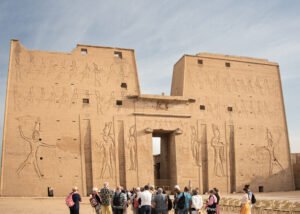
- The temple features a massive entrance pylon (gates), designed to create a sense of power and sacredness among the visitors.
- A large open courtyard follows the entrance, once used for public religious gatherings during the Ptolemaic age.
- The structure includes a hypostyle hall with tall columns that supported a heavy stone roof.
- Deeper inside the temple lies the sanctuary, which is the most sacred area, and a statue of the god Horus is kept there.
- The walls are covered with relief carvings and inscriptions that describe rituals, offerings, and festivals. Also, it contains side chambers and storage rooms used by priests for sacred objects.
Is the Edfu Temple Rediscovered?
Yes, the temple of Edfu was rediscovered by Auguste Mariette in the mid-1800s. The temple is situated near the Nile and with desert on the side, so over the years the temple got covered with sand and Nile silt, which covered the whole temple. Most people thought that there was nothing and also started living there.
By the 19th century, when temple pylons were discovered, the sand and silt were moved aside. But this submergence in the sand has benefited the temple because it stayed protected from weather and invasions that are usually done for looting purposes.
A few important points about its rediscovery:
- For centuries, the temple of Edfu was largely buried under 12 meters of sand and debris, which helps to protect the temple.
- Although it was buried beneath the layers of soil and sand, it remained remarkably well preserved.
- By the 19th century, European traveler and archeologist Auguste Mariette started the excavation and uncovered the temple in the early 1860s.
- Removing the sand and settlement debris revealed the temple’s huge walls, inscriptions, columns, and carvings.
- After the excavation, conservation work helped to protect the carvings and structure of the temple.
- Its impressive size and preservation make it one of the most important surviving temples.
Learn More:- Why is the Temple of Edfu important?
Temple of Horus
The temple of Horus at Edfu is a prominent place significantly dedicated to the god Horus. He was one of the most important gods in ancient Egyptian religion, believed to be the divine protector of the pharaoh. His falcon form represented sharp vision and power, symbolizing how a ruler should watch over the kingdom. At Edfu, Horus was worshipped specifically as Horus of Behdet, a local form associated with cosmic protection. Also, the temple celebrates the mythical battle between Horus and Seth, where Horus defeats chaos and restores balance.
Many wall carvings show Horus crowning the pharaoh, reinforcing the idea that royal authority came from the gods. One annual Festival of the Sacred Marriage was performed here, symbolizing harmony between divine forces Because of this deep connection, the Temple of Edfu became a center of political symbolism as well as religious devotion during the New and Middle Kingdoms.
What Do the Four Sons of Horus Represent?
The Four Sons of Horus were important protective deities in ancient Egyptian funerary religion. They were believed to protect the internal organs of a deceased person after mummification and to help safeguard the body for the afterlife. The four deities were Imseti, Hapy, Duamutef, and Qebehsenuef.
Imseti: Protector of the Liver
Imseti, shown with a human head, was associated with the liver. He was connected with the protection of the deceased and was traditionally under the protection of the goddess Isis.
Hapy: protector of the lungs
Hapy was usually represented with the head of a baboon and protected the lungs. He was traditionally associated with the goddess Nephthys.
Duamutef: Protector of the stomach
Duamutef had the head of a jackal and was associated with the stomach. His protective goddess was traditionally Neith.
Qebehsenuef: Protector of the intestines
Qebehsenuef was represented with the head of a falcon and protected the intestines. He was traditionally associated with the goddess Serket.
| Sons of Horus | Head | Organ Protected | Associated Goddess |
| Imseti | Human | Liver | Isis |
| Hapy | Baboon | Lungs | Nephthys |
| Duamutef | Jackal | Stomach | Neith |
| Qebehsenuef | Falcon | Intestines | Serket |
Together, the Four Sons of Horus represented the protection of the organs of the deceased. They are traditionally used in canopic jars to hold and protect the organs removed during mummification.
Edfu Temple Opening Hours and Tickets
Edfu Temple is one of the best-preserved temples in Egypt and is open to visitors throughout the week. The easiest and most convenient way to visit this temple is as part of a Nile journey between Luxor and Aswan.
According to the Egyptian Ministry of Tourism and Antiquities, the current visiting hours are
| Days | Timing |
| Sunday | 6:00 AM – 5:00 PM |
| Monday | 7:00 AM – 5:00 PM |
| Tuesday | 7:00 AM – 5:00 PM |
| Wednesday | 6:00 AM – 5:00 PM |
| Thursday | 7:00 AM – 5:00 PM |
| Friday | 7:00 AM – 5:00 PM |
| Saturday | 7:00 AM – 5:00 PM |
Visitor tip: Allow at least 1-2 hours to explore the Edfu temple properly. The temple can be busiest between 9:00 AM and 3:00 PM. If possible, visit early in the morning to enjoy a quieter experience and comfortable temperatures. The morning light also makes it easier to appreciate the temple’s huge entrance, detailed reliefs, columns, and inscriptions.
Note: The timings may change because of holidays, special arrangements, or changes made by the authorities, so try to check the latest information before the trip.
Edfu Temple Ticket Prices
The entrance fee for Edfu Temple depends on whether you are an international visitor or an Egyptian visitor, with reduced prices available for students. The current prices published by the Egyptian Ministry of Tourism and Antiquities are
| Visitor’s Category | Price |
| International adults | EGP 550 |
| International students | EGP 275 |
| Egyptian adults | EGP 40 |
| Egyptian students | EGP 20 |
Note: The prices listed above can change, so it is recommended to check the official information before visiting. If you are an international student, try to bring your identification card to get the student rate.
Key facts about the Edfu temple
- The Edfu temple is located in Edfu, between Luxor and Aswan in southern Egypt.
- The temple is dedicated to the falcon-headed god, Horus.
- It is considered the second largest temple from ancient Egypt, after the vast Karnak temple complex at Luxor
- Edfu Temple is included in Egypt’s UNESCO Tentative List as part of the group of Ptolemaic and Roman temples in Upper Egypt.
- Priests once performed daily rituals at the temple, including prayers and offerings to the gods.
- Ancient religious rituals are no longer performed at Edfu Temple. Today, it is mainly a historical and archaeological site visited by tourists.
- Edfu is one of the best preserved temples, with many original carvings and inscriptions still visible.
Tips to Follow while Exploring the Temple of Edfu
- Visit early in the morning, as then the temple has fewer crowds and you can experience the calm scenery. It is suggested by the Swan Dahabiya tour guides that if possible, you should visit the temple of Horus at Edfu early in the morning.
- Only visit with the tour guide if you are taking Dahabiya Nile Cruises; then the tour guide is provided usually by the cruising company for an informed exploration.
- Wear comfortable walking shoes, as you need to walk a lot in the temple. Also keep sunglasses, a water bottle, and sunscreen, especially if you are exploring during Egyptian afternoons.
- Do not climb or do flash photography, especially in the areas where it’s prohibited. Respect temple rules, as it is one of the sacred religious places in Egypt.
Faqs
How long did it take to build the Temple of Edfu?
The construction of the ancient Edfu temple lasted for nearly 180 years, from the reign of Ptolemy III to the Roman period.
Can tourists enter the inner rooms of the temple?
Yes, visitors can walk through courtyards and halls and even reach the sanctuary area, making it an immersive and relatable experience.
What makes Edfu Temple different from Karnak or Luxor Temple?
Edfu is more complete and easier to visualize because much of its original roof, corridors, and inscriptions still survive. Also, it’s well preserved and provides a much clearer view of carvings on the walls of the temple.
Is the Temple of Edfu suitable for students and educational trips?
Absolutely. The clear carvings and layout make it ideal for learning about ancient Egyptian religion and architecture. This temple is a gem for history lovers and explorers, and also for the people who have a keen interest in architecture.
What is the best time of day to visit the Temple of Edfu?
Early morning is best for cooler weather, fewer crowds, and better photography. Also, the sun creates beautiful scenery that can complement the exploration journey to the temple. Tourists are also allowed to take Temple of Edfu photos, but flash photography is prohibited.
Are rituals still performed at the Edfu temple?
No, religious rituals are no longer performed at the Edfu temple. However, in the past, Egyptian priests came to the temple to worship Horus, a falcon-headed god. Today, the temple is a major historical site and tourist site. Viisitors can still see the places where these ancient rituals once took place.
Is Edfu worth visiting?
Yes, Edfu Temple is worth visiting, as it is one of the best-preserved ancient Egyptian temples. The temple has huge walls, beautiful carvings, statues, and ancient inscriptions. While visiting the temple, you will get a chance to learn about the story of Horus and the religious beliefs of ancient Egyptians.