


The Temple of Luxor is located on the east bank of the Nile in the city of Luxor, ancient Thebes. It’s a connected temple with the large Karnak complex, with a ceremonial road. The east banks are one of the prominent regions where large populations settled during the Middle and New Kingdoms. This monument is one of the most symbolic and elegant temples of ancient Egypt; from statues to pylons of Ramesses II, there is proof that the archeological advancement of that time has structured a temple in a way that its existence is becoming a learning stage for ancient rituals and Egyptian practices.
During the Dahabiya cruise trip with Karnak Temple, many passengers also explore Luxor Temple. The historical monument is known for its harmonious and historical significance. Let’s explore the temple of Luxor in detail with the following sections, from the architecture to the cultural significance.
Temple of Luxor—Introduction
Today, the temple is part of modern Luxor; in ancient times, the region was known by the name Thebes. The temple was constructed around 1400 BCE, a time period roughly coinciding with the early rise of the New Kingdom in Egypt. In the ancient Egyptian language, the Temple of Luxor is known as the Ipet Resyt. In English words, it means “the southern sanctuary,) part of the primary temple on the east bank.
The temple is unique because there is no deity worshipped, but the temple is dedicated to the rejuvenation of kingship. In simple words, it means that a pharaoh has re-established their power and connection with the eternal forces. It is mostly believed that pharaohs remembered God Amun-Ra to take help in stabilizing societal and cosmic order. A special festival, the Opet Festival, is also celebrated every year at the Karnak and Luxor temples, where religious ceremonies and processions are performed.
Where is the temple of Luxor located?
It is located on the east bank of the Nile along the ancient city of Thebes (modern-day Luxor). The part of land where Luxor Temple is constructed comes under Upper Egypt and is positioned within the urban modern landscapes. Here tarvelers have easy access to hotels, markets, and restaurants. The area of the temple and Luxor City comes under the UNESCO-listed Ancient Thebes archaeological area, which makes it the central historical landmark in Luxor City.
Do you know there is a reason why more temples are located on the east bank of the Nile River? Well, the west side of the Nile River is reserved for the mortuary and burial monuments like the Valley of the Kings. There, you will see the funerary temple and tombs of major pharaohs of ancient Egypt. The strategic location of these monuments is not a coincidence; the sun sets to the west. That’s why the pharaoh’s burial monuments are constructed on that side of the river.
What is inside Luxor Temple?
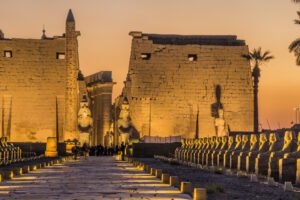
- The temple’s grand entrance is marked by the First Pylon, built by Ramses II, and the Colossal statues of Ramses II guarding the entrance.
- One remaining granite obelisk; the second stands in Paris, and the processional colonnade (grand roofed walkway) was built by Amenhotep III.
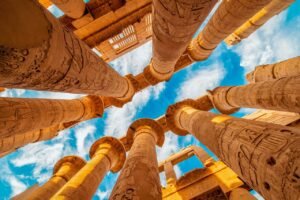
- Hypostyle court with well-preserved columns and reliefs. The travellers still see while exploring the Luxor Temple from inside.
- A chapel during the Roman period was converted into a church and later a mosque around 640 AD. The Mosque of Abu El-Haggag is still active within the temple complex.
Luxor Temple facts
- Construction began around 1400 BCE under Amenhotep III and was then expanded by Tutankhamun, Horemheb, and Ramses II.
- The temple is dedicated to the Theban triad, which is Amun, Mut, and Khonsu. (They are father, mother, and son, seen as eternal powers responsible for handling different responsibilities.)
- The Opet Festival is celebrated every year; unlike other temples, it was ruled by different rulers at different times.
- It’s been a hotspot for worship for centuries, and still, because of the mosque, daily religious rituals are carried out in the historical monument from the age of the pharaohs.
- The Luxor temple photos are widely available, and they show the symmetrical design and open courtyards. The columns and statues create strong visual perspectives. It is also a good spot for travellers to take photographs.
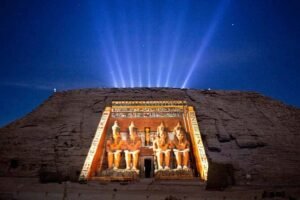
- Luxor Temple at night is dramatically illuminated after sunset, lighting highlights columns, statues, and hieroglyphs. It creates a calm and atmospheric visitor experience, but is less crowded compared to daytime hours.
FAQs (Frequently Asked Questions)
What are the timings for the Luxor Temple?
The timings of the Luxor Temple are 6 AM to 8 PM, usually in winter; in summer, the temple remains open till 10 PM as well. Mostly, the temple is explored best in daylight, and also most cruises stop at that time.
What is the best way to reach the Luxor Temple?
To reach the Luxor Temple with comfort and luxury, board a Swan Dahabiya cruise from Aswan and explore all the historical places along the Nile. Then Luxor will be your last shore excursion, and after that, you can end your cruise trip.
Why is Luxor Temple different from other temples in ancient Egypt?
All other temples have their single god and different stories around them. But the Luxor Temple is related to the Karnak Temple; it is not dedicated to any god but recognized as a solace for the rejuvenation of the kingship. Every year during the Opet Festival, the statues of the Theban triad are paraded through the ceremonial road; this marks their uniqueness.
How to make Luxor Temple exploration easy?
For exploration of the Luxor Temple, an expert tip for every traveler is that you must visit along with the Karnak Temple on best dahabiya nile cruise itineraries. It saves time, you can explore in depth, and it also helps in understanding the historical significance of both temples.
Is the ceremonial road connecting Karnak and Luxor Temple open for tourists?
Yes, the avenue to the Sphinxes, the connecting road between Luxor and Karnak Temple, is open for tourists to explore. Usually, people explore the road during sunsets for photography purposes.