


The sandstone monuments that are historically rich—have you ever thought about that? From where were all these stones mined? Do they come from other countries? Well, not as a tourist to Egypt. On your cruise trip, you will pass by a famous location in Egypt, Gebel el-Silsila; this is the place from which most of the stones are mined for great architectural monuments.
Before this, let’s understand what Gebel el-Silsila is and why it is called so. In this piece of content, you will know a lot about the Gebel el-Silsila, from its importance to why it is a tourist spot.
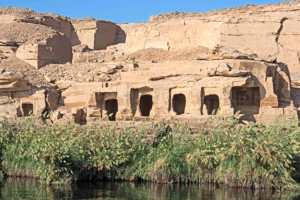
Gebel el-Silsila—Introduction
The name Gebel el-Silsila, in Arabic, means “mountain of chain.” It is called that because the cliffs are situated in a row along the Nile River, which makes it narrow and the flow of the river fast. In archeology, the place Gebel el-Silsila is not just a row or an iron chain; it is a location from where stones have been mined for the construction of great temples like Luxor and Karnak.
In ancient times, or during the Pharaonic age, the stones from Gebel el-Silsila were mined and transported easily. The stone gets cut easily and is directly boarded on ships for transporting it through the Nile waters. This is the major reason why it has become a major spot to explore on the Nile while cruising between Edfu and Kom Ombo. In ancient Egypt, it was one of the most significant religious and industrial sites, but unlike other monuments, this palace is known for shrines, quarries, and rock-cut chapels.
Gebel el-Silsila was famous for what?
It is the primary sandstone quarry in ancient Egypt; for temples, tons of stone blocks are transported.
Temples like Luxor, Karnak, and Ramesses are built with stone blocks taken from the Gebel el-Silsila.
Geographically, in this area, the Nile is covered with cliffs, which makes it narrow and a major spot to control the Nile traffic; the flow of current changes, and passengers on the Dahabiya Nile cruise in Egypt get to see amazing views from the decks.
A major center for quarrying during the New Kingdom period, also known for rock inscriptions left by workers, officials, and priests. The shrines at Gebel el-Silsila are directly carved into the rocks.
History—Gebel el-Silsila
In ancient times, especially during the Middle and New Kingdoms, major stone extractions were performed there for the building of temples. Pharaohs such as Hatshepsut, Thutmose III, Seti I, and Ramses II have carried out major quarry operations and have overseen them. During that time, stone blocks were directly transported through the Nile.
The shrines and other places are also carved for religious purposes and for safe mining, so it is not a complete mining site in ancient Egypt. Hold a bunch of cultural and religious values, as inscriptions have records of royal authority, worker organization, and religious devotion related to the Gebel el-Silsila.
Gebel el-Silsila Tours and Tickets
The tour to Gebel el-Silsila is usually included with the cruising between Aswan and Luxor; no special boat or cruise is required. While sailing from Kom Ombo to Edfu, passengers see the stone quarries on both the western and eastern parts.
During the tour, while crossing the quarry, the passenger can see it getting narrow and stretching back once they cross the quarry.
Tickets for Gebel el-Silsila are generally inexpensive compared to museums or temples, but if someone is exploring on the Swan Dahabiya itinerary, then the fees are included in the packages.
It is always preferred by experienced travellers that exploring Gebel el-Silsila is only beneficial with a tour guide, as they explain to you the historical and religious significance in depth. It helps travellers understand the place and its value.
Some Commonly Asked Questions
Is Gebel el-Silsila suitable for all travellers?
The site is best for history lovers, explorers, and adventure-oriented visitors. To explore the site, travelers may have to walk through uneven stones, as the site is not reconstructed; travelers explore it as it was centuries ago.
Can I visit Gebel el-Silsila independently?
No, independently travelling just to Gebel el-Silsila is difficult due to limited transportation. Only preferred to explore while on cruise journeys, also one of the best ways to explore the site, as it is on the shore; travellers can see it directly from the decks of Dahabiya cruises, also.
Are tickets required to enter Gebel el-Silsila?
Yes, an entry ticket is required but mostly arranged by the tour partners or cruising staff, as the Gebel el-Silsila is one of the locations explored on the cruising itineraries.
Can I take photographs at Gebel el-Silsila?
Yes, travellers can take the photographs, but flash photography is not allowed near the inscription to protect it from damage. Can take pictures without flash of the sandstone quarry.
Is Gebel el-Silsila safe to visit?
Yes, the site is completely safe for visiting with families and for solo travellers also; usually, the site is explored in groups as per cruises. It is advised for travelers to remain on the designated paths for extra safety and easy exploration.