


Table of Contents
-
Introduction
-
Who was Amelia Edwards?
-
The A Thousand Miles Up the Nile Route
-
List of Historical Places and Cities Amelia Edwards Visited During Her Journey
-
Amelia Edwards’ Dahabiya Journey vs. a Swan Dahabiya Today
-
What has changed since 1873?
-
Conclusion
Introduction
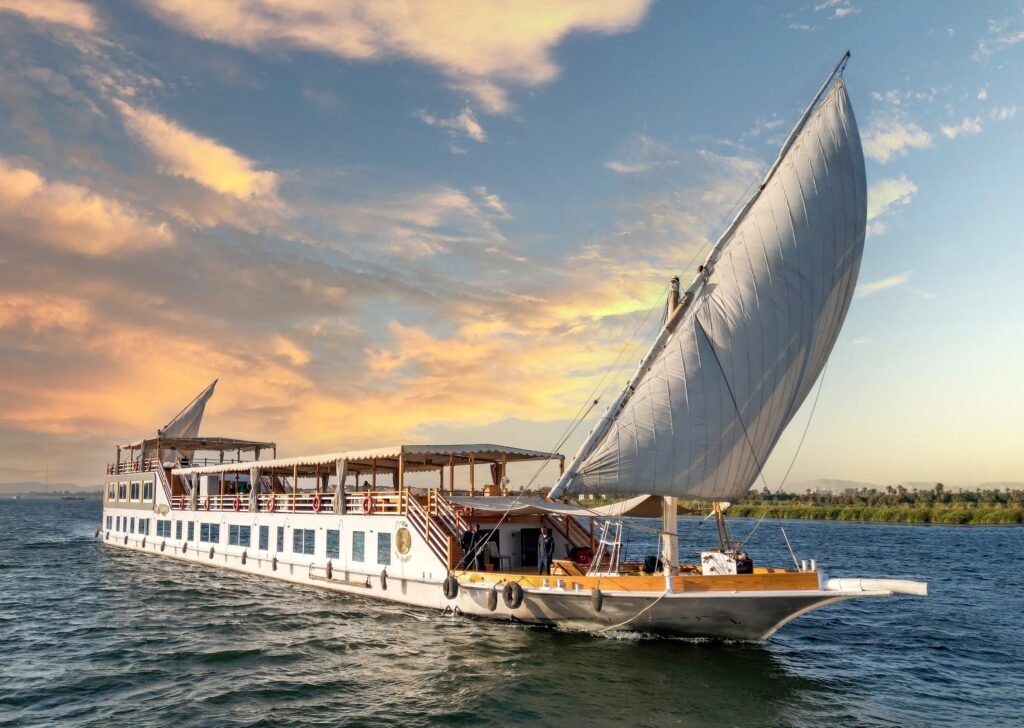
Long before the modern Nile cruises became popular in Egypt, travelers of that era sailed between the ancient temples and the river towns. One of the best-known accounts of this kind of journey was written by British writer Amelia B. Edwards, as in 1873 she traveled up the Nile by dahabeeyah (which is now known as Dahabiya), the traditional sailing boat that is used by travelers on the river. Her journey later became the book A Thousand Miles Up the Nile, first published in 1877.
This book records a lot about the Egyptian culture and history, much more than the temples and tombs, as the Edwards have written about the river, villages, desert landscapes, boats, people, travel conditions, and the historical monuments that she has visited.
More than 150 years later, some parts of her route, which she used to explore the Nile, are still being followed by many cruising itineraries. The boats, towns, and travel conditions have changed, but many of the monuments and Nile landscapes remain the same. This makes the Amelia Edwards Dahabiya Journey an interesting way to look at both the history of Nile travel and the modern experience. Learn about her journey and famous book through this blog.
Who was Amelia Edwards?
- Amelia B. Edwards was a British writer and traveller.
- She arrived in Cairo on 29 November 1873 and soon began looking for a dahabeeyah for her journey south.
- Her book gives a detailed picture of what travelling on the Nile was like in the 19th century. She describes her boat, the crew, sailing conditions, and the practical problems of moving a large boat along the river.
- Her dahabeeyah was very different from a modern Nile cruise vessel.
- It was a shallow, flat-bottomed wooden boat that could sail or be moved by rowing and tracking.
- Edwards even explains why she preferred the traditional dahabeeyah (in modern times known as Dahabiya) to some newer forms of river transport.
- Her journey was not simply a holiday cruise.
- It was a long travel expedition through Egypt and Nubia, with many archaeological stops along the way.
The A Thousand Miles Up the Nile Route
It is important to understand that Edwards did not follow the same short Aswan-to-Luxor itinerary that many modern travelers take in general. She has begun her journey in Cairo and continued south through Upper Egypt to Aswan and then farther into Nubia. Also, she travelled to Abu Simbel and the Second Cataract before returning north. Some places, including Abydos, were also visited on her return journey.
The chapter list of A Thousand Miles Up the Nile, which gives a useful picture of the route, says that she has explored Cairo, Sakkarah, Memphis, Minieh, Siût, Denderah, Thebes, Esneh, Aswan, Elephantine, Philae, Korosko, Abu Simbel, the Second Cataract, Nubia, Silsilis, Edfu, Thebes again, and finally Abydos and Cairo. That’s why her book and journey are famous; that’s why treating her journey as one modern cruise itinerary is better to look at the important places she encountered along the way so you can understand why Nile riverbanks are important in Egyptian history.
List of Historical Places and Cities Amelia Edwards Visited During Her Journey
Cairo: Where the Journey Began
Edwards arrived in Cairo before beginning her Nile journey. Her early chapters of the book describe the city with the bazaars, mosques, streets, and the Great Pyramid, and in the book it is mentioned that one of her first practical tasks was finding a dahabeeyah.
She describes visiting the boats at Boulak (a riverside city), where many Nile boats were available for hire. Well, choosing a suitable boat was not a simple process, but after finding one, the Edwards also describe the size and design of a dahabeeyah and the work of the captain and crew. This is one of the most useful parts of her book that helps in understanding Victorian Nile Cruise History. It says that a dahabeeyah was not simply transport; it is a vessel. For a long journey and is like a home on the river.
Today, Cairo is still an important starting point for many international visitors to Egypt, but travellers have airports, hotels, roads, and modern transport that make the journey to the Nile much easier than it was for Edwards at that time.
Following Amelia Edwards’ Nile Journey: From Upper Egypt to Abydos
After leaving Cairo, Amelia Edwards continued south along the Nile, stopping at important archaeological sites and river towns. Her journey was not a simple cruise from one famous temple to another, and the river was her main road, and reaching many monuments meant leaving the dahabeeyah and travelling overland, which made her feel connected to the history.
Sakkarah, Memphis, and Denderah
The Sakkarah and Memphis were among the early places connected with Edwards’ exploration of ancient Egypt, and her journey that she describes in her book shows how closely Nile travel and archaeology were linked. Travellers can spend part of the day on the river and then leave the boat to explore temples, tombs, and ruins.
Then she continues towards the south; the Edwards then reach Denderah (the modern Dendera), where she explores the Temple of Hathor. She paid close attention to its large columns, carved reliefs, and inscriptions, and the temple was not only an archaeological site; it was also part of the wider Nile landscape that she was slowly travelling through, which is what she described in her account.
Visitors can still see the Temple of Hathor today with a private Dahabiya Nile cruise journey. The major difference is now that travellers can easily reach there, but Edwards was on a long expedition, while modern visitors can reach Denderah through organised excursions as well.
Luxor and Ancient Thebes
The Luxor, which is known as part of ancient Thebes, was one of the major highlights of her journey as Amelia Edwards explored the temples and monuments around Thebes and wrote about their enormous size and detailed decoration as she saw Karnak, Luxor Temple, and the monuments on the West Bank, which a modern Swan Dahabiya journey also includes its major Luxor sights, including Karnak, Luxor Temple, the Valley of the Kings, and Hatshepsut Temple. The monuments remain, but the surroundings and the way travellers experience them have changed greatly since 1873.
Esna, Aswan, and Philae
Edwards then continued towards the south to explore the Esna and then Aswan. For her, the Nile was both the route and the center of daily life that she described in her book. Also, she talks about how sailing depended heavily on wind and river conditions, and moving through difficult parts of the river was taking a considerable effort from the crew. Around Aswan, she described the rocks, islands, and the First Cataract and also mentioned that the landscape became very different from the Nile Valley, which she saw in the north.
Philae was another important part of her journey, and Edwards described its island setting and the relationship between the temple and the surrounding water. Modern visitors can still visit the temple complex, although they are not seeing it in exactly the same location as the Philae, which was later moved to the Aglikia island to protect it from rising water after the construction of the Aswan High Dam.
Abu Simbel and the Second Cataract
Amelia Edwards travelled further south than a normal modern Aswan–Luxor cruise, and her journey continued through Nubia to Abu Simbel and the Second Cataract. This part of the A Thousand Miles Up the Nile route shows just how long and demanding her expedition was. During her time here, she recorded the desert landscape, Nubian villages, ancient monuments, and the challenges that she faced while sailing towards the south.
The Return Journey: Edfu, Kom Ombo, and Abydos
After reaching the southern destination, the Edwards then travelled north again. Her book includes Silsilis and Edfu during this return journey. The Edfu’s Temple of Horus remains a major Nile attraction even today, and it is also included in modern dahabiya itineraries such as Swan’s Aswan-to-Luxor journey. Then the Kom Ombo is another familiar modern Nile stop, but today the journey has become much easier than the Edwards’ expedition.
Then she visited Abydos on her return journey, and the final chapter of her book is titled “Abydos and Cairo.” This means her journey was not simply a straight route from Cairo to Aswan, but it was a much longer expedition that went south into Nubia and then turned north again.
That is what makes the Amelia Edwards Dahabiya Journey so interesting even today for many travelers. Modern travellers can visit many of the same ancient places, but they explore with modern luxury Dahabiya Nile cruise vessels, roads, guides, and facilities.
Amelia Edwards’ Dahabiya Journey vs. a Swan Dahabiya Today
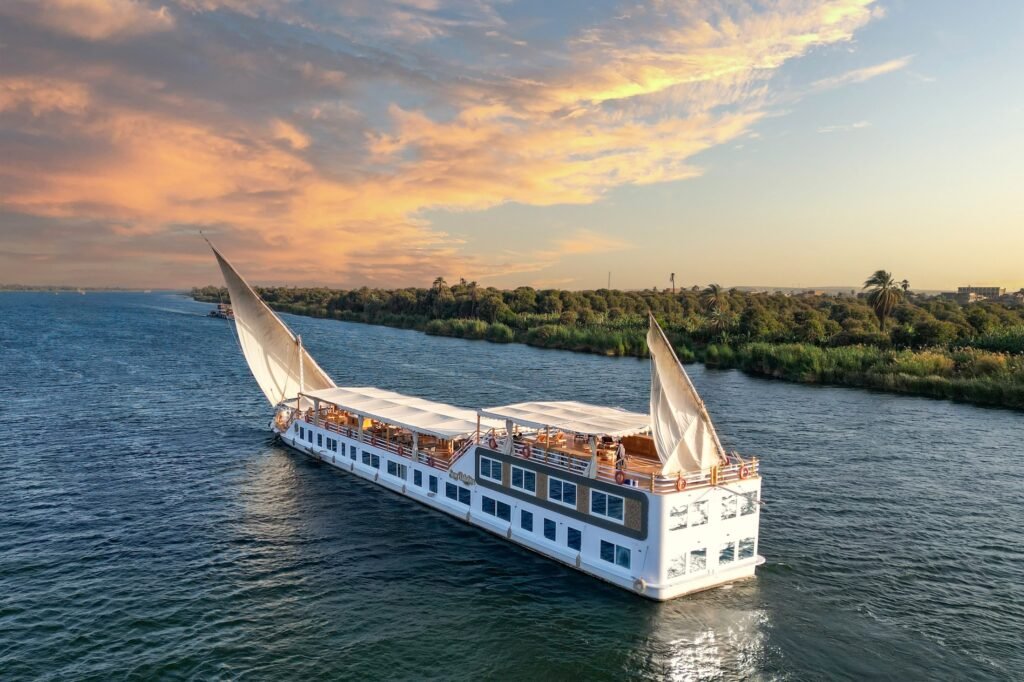
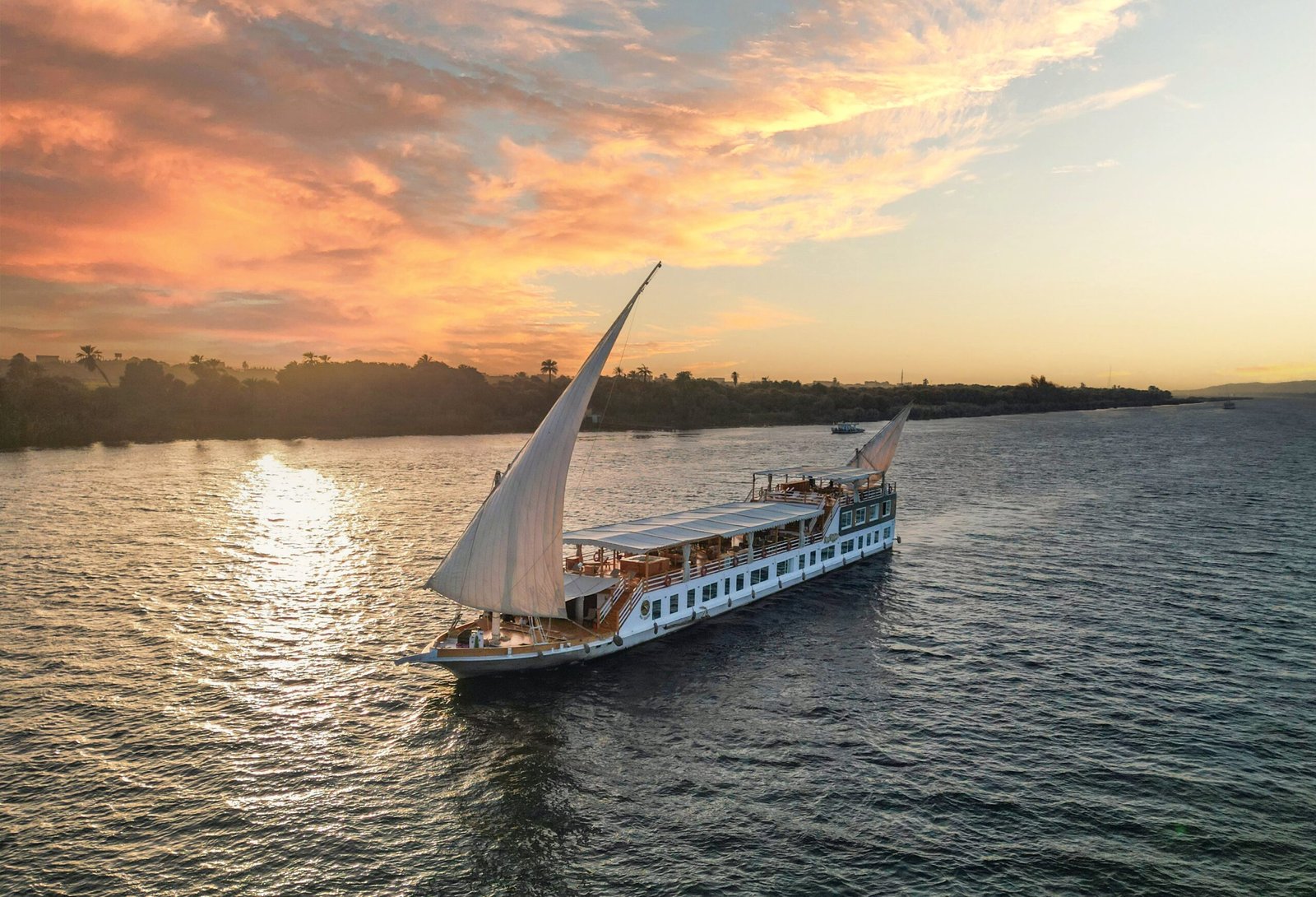
The strongest connection between Edwards’ journey and modern dahabiya travel is the boat itself, but the experience has not remained the same.
| Amelia Edwards, 1873 | Swan Dahabiya today |
| Traditional wooden dahabeeyah | Modern dahabiya |
| Long expedition | Planned cruise itinerary; duration varies by 3, 4, or 7 nights. |
| River conditions strongly affected travel. | Modern operations support the river journey. |
| Basic period accommodation | Modern cabins and guest facilities |
| Limited communication | Effective internet connectivity available |
| Archaeological exploration | Guided sightseeing |
| Very long journey into Nubia | Modern routes only visit between Luxor and Aswan. |
What has changed since 1873?
A lot has changed since Edwards travelled through Egypt. Like there are now airports, roads, hotels, organized tours, modern guides, conservation programs, and easier access to archaeological sites. The monuments have also been affected by conservation and changing water levels. Philae is a clear example, but some things remain recognizable.
The Nile still passes agricultural land and desert. Ancient temples still stand beside the river, and Aswan still has its distinctive rocky landscape. Also, the Luxor still brings together the river, temples, and ancient Thebes. This is what makes reading Edwards useful today for many international travelers.
Conclusion
Amelia Edwards’ journey shows just how different Nile travel was in 1873. Her dahabeeyah was her home, transport, and base for exploring Egypt, while the river connected her to ancient temples, villages, and landscapes, and today, travellers can follow parts of the same route in much more comfort.
So, if you want to experience the Nile at a slower pace and see many of these historic places from the river, a modern Swan Dahabiya journey can offer you a comfortable way to explore the Aswan–Luxor route while enjoying the traditional feel of sailing on the Nile. For booking, contact the Swan Dahabiya team now.