


Everything about Ramses III—The Last Pharaoh of the New Kingdom
Table of Contents
-
Introduction
-
Who was Ramesses III?
-
How did he become the pharaoh Ramesses III?
-
How long did Ramses III rule?
-
What did Ramses III look like?
-
Ramses III’s Achievements
-
Ramesses III’s family tree
-
How many wives did Ramses III have?
-
What is the Harem Conspiracy?
-
How old was Ramses III when he died?
-
About the Ramesses III’s Mummy
-
Is Ramses III linked with Ramses II?
-
Conclusion
Introduction
In Ancient Egypt, Ramses III is recorded as the pharaoh of the twentieth dynasty of the New Kingdom; he is the one who has seen multiple invasions, internal economical problems, and the decline of Egyptian political power. In this blog, learn in detail about Ramesses III.
Who was Ramesses III?
The Usermaatre Meryamun Ramesses III was the second pharaoh in the 20th dynasty of the New Kingdom. Some scholars who have studied and researched the Egyptian history say that he was born in 1217 BC and died in 1154 BC.
How did he become the pharaoh Ramesses III?
Ramesses III was born into the royal family of Egypt’s twentieth dynasty, making him a legitimate heir to the throne, as he was the son of the pharaoh Setnakhte, who is known as the founder of the twentieth dynasty and who established a new ruling line after a period of political instability in ancient Egypt.
Following the death of Setnakhte, Ramesses III inherited the throne according to the traditional system of royal succession practiced in Ancient Egypt, and he assumed the throne around 1185 BCE, taking the royal throne name Usermaatre Meryamun Ramesses III, a title that reflected his authority and divine connection as king. As the new ruler, he inherited an Egypt facing growing challenges, including external invasions, economic strain, and internal unrest.
How long did Ramses III rule?
Ramesses III ruled Egypt for approximately 31 years, which makes him the longest-ruling pharaoh of the twentieth dynasty. His reign began at a time when Egypt was facing increasing pressure from both foreign invasions and internal economic difficulties. After that, one of his earliest priorities was strengthening Egypt’s military to defend the country’s borders from external threats.
He successfully defeated the Sea Peoples during the Battle of Djahy and the Battle of the Delta, preventing their invasion of Egypt, and also led campaigns against Libyan tribes, securing Egypt’s western frontier and maintaining territorial stability. Although his military victories protected Egypt, repeated wars placed a heavy burden on the kingdom’s economy and resources.
During his reign, Egypt experienced shortages of supplies and financial strain, which contributed to growing social unrest, and one significant event of his rule was the first recorded labor strike in history, when workers building the royal tombs at Deir el-Medina stopped working because their food rations were delayed. Despite these challenges, Ramesses III continued large-scale building projects, including the construction of his impressive mortuary temple at Medinet Habu, which became one of the finest temples of the New Kingdom, and his reign marked the final period in which a New Kingdom pharaoh exercised strong military and political authority over ancient Egypt.
What did Ramses III look like?
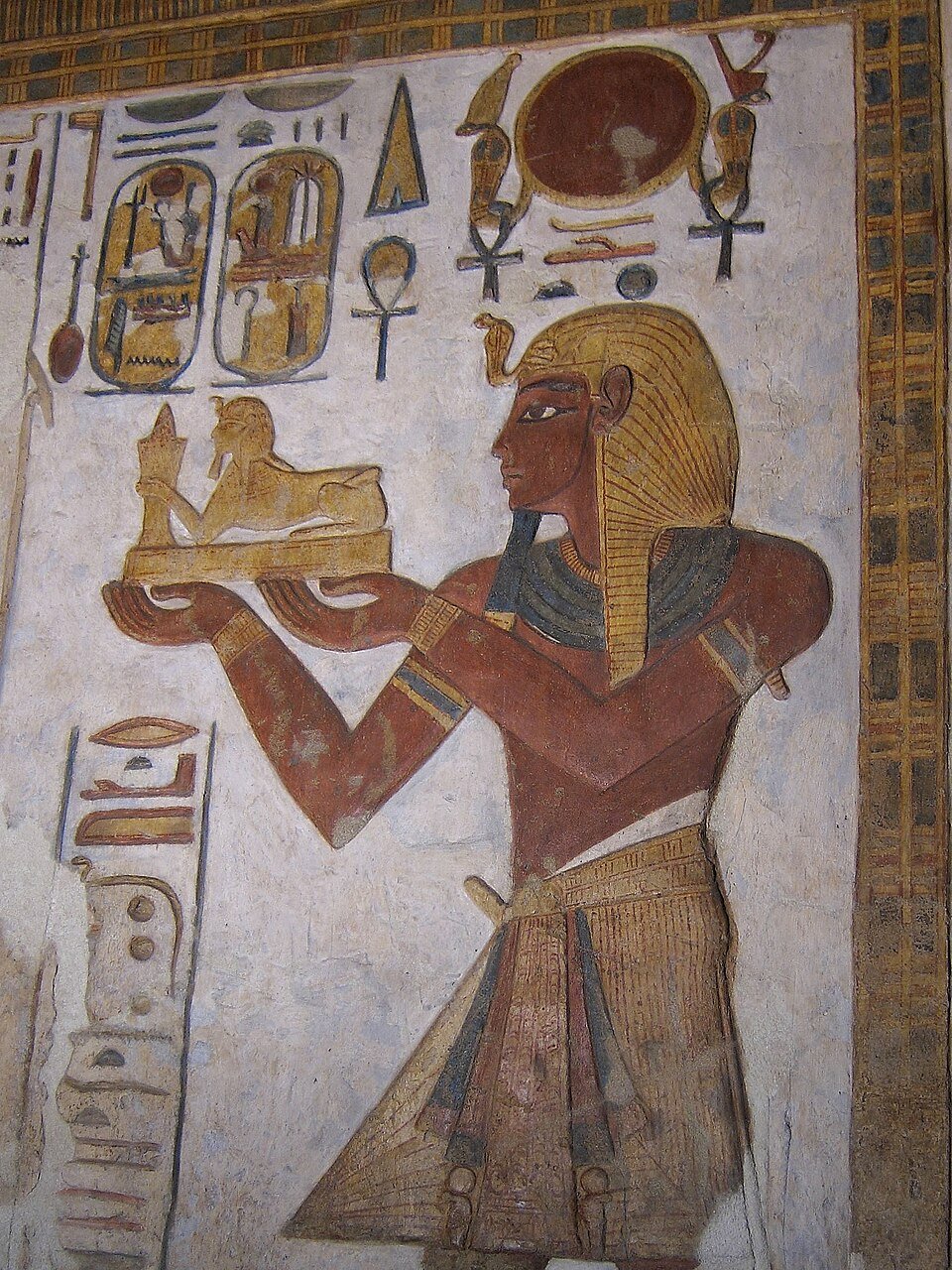
The exact appearance of Ramesses III cannot be known with complete certainty. Historians rely on surviving statues, temple reliefs, and his well-preserved mummy to understand how he may have looked.
In royal artwork, Ramesses III is typically shown as follows:
- Wears traditional pharaonic regalia.
- Elaborate crowns.
- The sacred uraeus cobra.
- The ceremonial false beard that symbolized kingship.
Like many Egyptian rulers, he is portrayed with an idealized youthful appearance, reflecting artistic conventions rather than an exact portrait. Modern examinations of his mummy provide valuable information about his age, health, and injuries, but they cannot fully reconstruct his facial features or overall appearance. You can find numerous pictures of Ramses III’s mummies on the internet with the verified sources to get the exact picture in your mind of how he must have looked.
Ramses III’s Achievements
The Great Harris Papyrus: Papyrus Harris I was created by Ramesses IV, the son and successor of Ramesses III, and It records the achievements and contributions of Ramesses III during his reign as The papyrus describes his donations of land, gold statues, valuable gifts, and resources for temples across Egypt and Nubia.
Support for Temples: Ramesses III donated wealth and resources to temples in many important cities, including for Pi-Ramesses, Heliopolis, Memphis, Abydos, Coptos, El Kab and several cities in Nubia This shows that he strongly supported religion and temple construction during his regime.
Copper Mining at Timna: Ramesses III sent officials to the copper mines at Timna in southern Canaan, where the copper was mined in large quantities. The metal was transported safely back to Egypt by ships, and the papyrus states that this was an important achievement not seen since earlier kings.
Temple Construction: Ramesses III rebuilt the Temple of Khonsu at Karnak on the foundations of an older temple built by Amenhotep III. Around his 12th regnal year, he completed his magnificent mortuary temple at Medinet Habu. The temple walls were decorated with scenes showing his victories over the Sea Peoples, both on land and at sea, and today, Medinet Habu is one of the best-preserved temples of the New Kingdom in Egypt that tourists see at the Karnak Temple complex during their Dahabiya Nile cruise journey.
Ramesses III’s family tree
Father: Setnakhte, who is the founder of Egypt’s Twentieth Dynasty and predecessor of Ramesses III.
Wives: Tyti, believed to have been one of Ramesses III’s Great Royal Wives and widely accepted as the mother of Ramesses IV. Tiye, a secondary wife associated with the Harem Conspiracy and believed to have been the mother of Prince Pentawer.
Sons: Ramesses IV, who is the son of Tyti and succeeded Ramesses III as pharaoh after his death. Pentawer, who is the son of Tiye, was allegedly involved in the Harem Conspiracy that attempted to place him on the throne.
How many wives did Ramses III have?
According to the historian, Ramses III only had two major royal wives:
Tyti: Believed to have held the title of Great Royal Wife, and she was commonly regarded as the mother of Ramesses IV, who succeeded Ramesses III.
Tiye: A secondary wife of the pharaoh and best known for her alleged involvement in the Harem Conspiracy, an assassination plot intended to place her son, Prince Pentawer, on the throne.
What is the Harem Conspiracy?
The Harem Conspiracy was a plot to assassinate Ramesses III, and it took place near the end of his reign, around 1155 BCE. This was led by one of the king’s secondary wives, Tiye, as she wanted her son, Pentawer, to become the next pharaoh instead of the chosen heir, and several palace officials, servants, and members of the royal court joined the conspiracy.
The conspirators planned to kill Ramesses III and replace him with Pentawer. An Egyptologist stated that ancient court documents describe how the plot was discovered and investigated. A special royal court was formed to put the accused conspirators on trial, where many people found guilty were sentenced to death or forced to take their own lives, and Prince Pentawer is believed to have died after the trial, possibly by suicide, although the exact details remain uncertain.
The modern CT scans of Ramesses III’s mummy revealed a deep cut across his throat, suggesting that the assassination was likely successful, but despite the conspiracy, Ramesses IV, the king’s chosen heir and also the son of his first wife Tyti, became the next pharaoh after Ramesses III’s death.
How old was Ramses III when he died?
The estimated age of death was around 60-65 years old, and the year of death is approximately around 1155-1154 BCE. The cause of death in the modern CT scans reveals that his mummy revealed a deep cut across his throat, indicating that he was likely killed during the Harem Conspiracy, a palace assassination plot by his second wife.
About the Ramesses III’s Mummy
Ramesses III was buried in Tomb KV11 in the Valley of the Kings, the royal burial ground for many New Kingdom pharaohs, and KV11 is one of the largest and most elaborate tombs in the Valley of the Kings, reflecting the importance of his reign. The walls of the tomb are decorated with detailed religious texts and artwork intended to guide the pharaoh’s journey into the afterlife. Although he was originally buried in KV11, his mummy was later moved by ancient priests to protect it from tomb robbers, and then Ramesses III’s mummy was rediscovered by antiquarians in 1886, making it one of the best-known royal mummies from ancient Egypt.
In 1980, researchers James Harris and Edward F. Wente used X-ray examinations to study the mummy, helping scholars learn more about his physical remains, and also the modern scientific studies of his mummy have provided valuable insights into his health, age, and the injuries that likely caused his death. In April 2021, Ramesses III’s mummy was ceremonially transferred from the Egyptian Museum to the National Museum of Egyptian Civilization during the internationally celebrated Pharaohs’ Golden Parade. Today, his mummy remains an important archaeological treasure, offering historians and researchers a deeper understanding of one of Ancient Egypt’s last great warrior pharaohs.
Is Ramses III linked with Ramses II?
Yes. Ramesses III and Ramesses II are linked by royal tradition and name, but they were not father and son. Ramesses II ruled during the Nineteenth Dynasty (1279–1213 BCE), whereas Ramesses III ruled about 90–100 years later during the Twentieth Dynasty (1185–1154 BCE). They belonged to different dynasties, so Ramesses III was not the son or direct successor of Ramesses II.
Both pharaohs used the royal name Ramesses (also spelled Ramses or Rameses) as The name Ramesses comes from the ancient Egyptian name Ra-mes-su, which means “Born of Ra” or “Ra has given birth to him. ” Ra was the ancient Egyptian sun god, and “mes-su” (ms) means “born of” or “child of.”
Conclusion
His reign marked the end of an era, after which Egypt gradually experienced political fragmentation and a decline in international influence, and despite these challenges, Ramesses III remains one of the most studied and respected rulers in Egyptian history. This is our short note on Pharaoh Ramses III to help the tourist know about the pharaoh from ancient Egypt.