


Table of Contents
-
Introduction
-
Where is the Temple of Hatshepsut located?
-
What is located by the cliffs of Deir el-Bahri?
-
When was the temple at Deir el-Bahri built?
-
Why did Hatshepsut build Deir el-Bahari?
-
Why is Deir el-Bahri important?
-
What is located by the cliffs of Deir El Bahri in Upper Egypt?
-
Conclusion
Introduction
Deir el-Bahri is located west of the Nile, in Luxor, which was known as Thebes in ancient times. The Temple of Deir el-Bahri is the mortuary temple of Hatshepsut, a major female pharaoh in the eighteenth century of the New Kingdom in ancient Egypt. The Deir el-Bahri complex was first home to Mentuhotep II’s tomb; a funerary temple existed there.
Cliffs around Deir el-Bahri make it a prime location for temples and burial grounds. Over the years, the carved temples between the cliffs attracted scholars who were interested in knowing about Egyptian civilization. With time and as history was recorded and recognized by the UNESCO World Heritage Organization, the Temple of Deir el-Bahri became a prime location for tourists to visit while on the Nile sailing journey.
In this blog, mention the temple of Deir el-Bahri and its historical significance with some archaeological facts that make it a hotspot for tourists to explore.
Where is the Temple of Hatshepsut located?
The mortuary temple of the queen Hatshepsut is located within the Deir el-Bahri complex. The temple’s location was strategically chosen by the advisor, Senenmut, an experienced architect under the reign of Hatshepsut. The design was inspired by the adjacent temple of Mentuhotep II, also built in Deir el-Bahri.
Hatshepsut is the sixth pharaoh in the New Kingdom of the 18th dynasty. She is powerful and compassionate; during her reign, she contributed a lot to building monuments. The purpose of building the mortuary temple is to show respect for the queen Hatshepsut to the god Amun. Still, the painting of God Amun and Hatshepsut can be seen on the walls. It was believed that it took around 16 years to complete, according to some research done by Egyptologists.
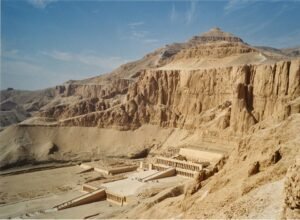
To the west of Luxor, the Deir el-Bahri complex is located. Surrounded by the cliffs, it seems like nature itself is complementing the temple structure. Tourists get exceptional backgrounds for photography. The best time to visit the temple is while on a Nile exploration journey by a Dahabiya Nile cruise in the early morning. The cliffs glow, and the shadows on the temple create visually appealing landscapes where history describes the greatness and mastery of ancient architecture.
What is located by the cliffs of Deir el-Bahri?
At the Deir el-Bahri complex, surrounded by cliffs, the mortuary temple of Hatshepsut, the mortuary temple of Mentuhotep II, and the mortuary temple of Thutmose III were located. In the 11th dynasty of the Intermediate Kingdom, the funerary temple of Mentuhotep II was built. Later in the New Kingdom, Senenmut proposed the idea of building the unique mortuary temple of Hatshepsut.
After the death of the female pharaoh Hatshepsut, attempts on the temple by Thutmose III were made. But despite its efforts, only some parts of the temple seem destroyed. It was still standing as a historical monument. Then Thutmose III also gets a temple designed just above the temple of Hatshepsut. That’s how the complex of Deir el-Bahri was related to three major pharaohs from ancient Egyptian history.
When was the temple at Deir el-Bahri built?
The temple at Deir el-Bahri, dedicated to God Amun and famous for Queen Hatshepsut, also known as Djeser-Djeseru, was built during the 18th dynasty, around 1479–1458 BCE. It was believed that the construction of the temple of Hatshepsut started shortly after she became a pharaoh. The project of the temple was started earlier, so it was completed near the end of the rule in 1458 BCE.
Why did Hatshepsut build Deir el-Bahari?
- In ancient Egypt, these historical monuments are seen as proof of the pharaoh’s legacy. Every pharaoh worships the god for stable growth and power.
- So, the queen Hatshepsut honored the god Amun; that’s why in the complex, there is also a temple of Amun situated.
- The construction of temples and monuments is believed to be seen as a celebration of the successful reigns and achievements of the pharaohs.
- It also served as a site for funereal rituals that honored the pharaoh’s death; the architectural detailing on these temples shows projected power, stability, and divine support.
- The symmetrical design of the stairs connecting the terrace with the ground creates a balanced visual design. It is clearly seen that the temple’s design was influenced by the later Egyptian architecture.
- Temple walls have beautiful and well-detailed carvings; scenes on the carvings depict the birth of Hatshepsut. The artistic beauty of the temple reflects the craftsmanship of the New Kingdom.
The construction of the temple has strengthened Hatshepsut’s political authority and also shows how she is related to the priesthood of the god Amun. Religious ceremonies were conducted regularly at the temple, symbolizing divine approval of her kingship.
Why is Deir el-Bahri important?
- The Deir el-Bahri complex is a cultural landmark in Egyptian history, famous for the unique design of the temple, which is surrounded by cliffs.
- It provides valuable proof and knowledge about the burial practices of the pharaohs during the New Kingdom.
- The design of the temple demonstrates the mastery of architecture and engineering of the ancient Egyptian people. Also, the site provides important information about Hatshepsut’s reign.
What is located by the cliffs of Deir El Bahri in Upper Egypt?
Thebes, present-day Luxor, part of Upper Egypt, has the Deir El Bahri complex situated at the center of cliffs, a major tourist destination. The Temple of Hatshepsut, which is dedicated to the god Amun, is located by the cliffs of Deir el-Bahri in Upper Egypt. Every year, a significant number of tourists visit the location while on the luxury Dahabiya Nile Cruise trips.
Conclusion
The limestone cliffs of Deir el-Bahri in Upper Egypt are home to the temple of the powerful female pharaoh Hatshepsut. Today, Deir el-Bahri stands as a powerful example of ancient Egyptian design, religion, and royal ambition. The complex at Deir el-Bahri, constructed by Senenmut, honors the major Egyptian god Amun and is believed to protect the legacy of the queen Hatshepsut. All the above-mentioned features and strategic locations make it a must-visit for tourists in Egypt.
Other Useful Links: