


Today’s Egypt is shaped by a great history of different dynasties that ruled during different time phrases, so the Philae temple is a Greek-Roman architectural wonder that holds history and proof of cultural shifts in ancient Egypt. Even by UNESCO, the site is declared as a major spot for studying historical practices in Egyptian times.
It is one of the best-preserved temples, dedicated to the major god Isis. The goddess Isis in Egypt stands as proof of magic, motherhood, protection, and healing; she is the wife of Osiris and mother of the god Horus. To her, this unique temple on the island over the Nile is constructed. Originally in ancient times, the temple was constructed on Philae Island.
One of the major facts other than historical or cultural significance is that the relocation process of the Philae Temple makes it fascinating. The number of tourists every year gets amazed on knowing how the complete temple is shifted from one location to another. So, let’s know a little bit about its relocation and then the cultural and religious significance of the monument.
Philae temple, Great Rescue Mission
The temple is located on Philae Island originally; the island floods every year, and major destruction is happening to the historical monument. There are two threats of dams that made the Philae temple shift: one in 1902 when the Aswan low dam was built, and then another in 1906 when the high dam was constructed. With that, the temple totally gets submerged underwater. Then, it came to UNESCO knowledge, and a great rescue operation was launched; it’s a partnership program between the US and Egyptian governments.
Instead of creating a wall around it, the experts decided to move the complete temple to nearby Aglikia Island, which is 12 meters higher than Philae Island. So, the temple was cut into around 95,000 separate stone blocks, mostly weighing around 15 tons each. Then it assembled at the Aglikia Island. The projects for relocation were carried out between 1977 and 1980. One of the major relocation projects led by UNESCO, the world heritage organization.
Geography—Philae Temple
So the temple of Philae is a famous historical place, and historians like Strabo, Seneca, and Pliny the Elder have written about the place. The term “Philae,” the name of the temple, means two small islands near Aswan. That’s why it’s called Philae Temple, where the goddess Isis is worshipped. It is also the prime location for the Dahabiya Nile cruise passengers, as the temple is one of the shore excursions included in the itinerary. At some places it is also known as the Aswan Temple, as the Agilkia Island is situated near the city of Aswan.
What is inside Philae Temple?
The interior of the temple of Philae gives Greek-Roman briefs, as structures and shapes are made in a way. Interior walls are richly decorated with relief carvings and hieroglyphs that depict scenes of rituals performed for Isis, Osiris, and Horus. The columns feature floral capitals inspired by papyrus and lotus plants. Inner sanctuaries were restricted to priests in ancient times, and only they were allowed to perform sacred practices. Well, today these temples are merely just historic sites, and no rituals are performed. Chambers were used for offerings, processions, and sacred storage, and ceilings retain traces of original painted decoration during their construction. Mostly the interior layout follows traditional Egyptian temple design, but also in some places it reflects strong influences of Greek-Roman architecture.
Importance of Temple of Isis
The Temple of Isis at Philae was one of her most important cult centers and one of the monuments where solely Isis is worshipped. The goddess Isis symbolized motherhood, magic, and resurrection, and also the worship of Isis spread beyond Egypt to the Roman world, and a number of pilgrimages were performed by Romans for centuries. Rituals here focused on rebirth and divine protection, and priests performed daily ceremonies honoring the goddess. The temple architecture reflects devotion and symbolic design and also the influence of Isis in ancient religion and beliefs for the people of Egypt.
Learn about:- Why is the Philae Temple so important?
Philae Temple Facts
- The only temple that was relocated stone by stone under a major UNESCO project and largely studied and is still undergoing research to know more about Egypt’s history and secrets.
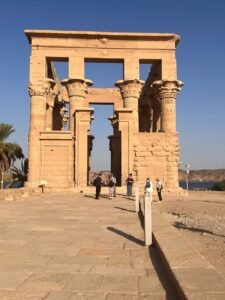
- The complex of the Temple of Philae also has the Kiosk of Trajan; in simple words, it means “bed of the pharaoh.” It’s a part of an unfinished Roman-era Egyptian temple that was later moved, and now people see it at the entrance of the temple.
- Inscriptions from the hieroglyphic texts are among the latest known inscriptions, which are also being studied today to learn more about Egyptian history.
- As the ancient proofs or hieroglyphs show, this great temple of Isis was once considered a pilgrimage site among Romans. Later on, it was influenced by Christianity during the British influence.
- The temple of Philae in Aswan is now a part of the UNESCO World Heritage Site.
When to see the Philae Temple sound and light show?
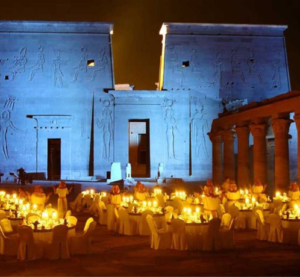
The nighttime experience of the Philae Temple is something that makes it an adorable site to visit. During the show myths around Isis and Osiris are stated, and the relocation process is shown. Through laser lights and projection, the show is conducted; it happens in multiple languages depending upon the day, like English, French, and Arabic.
The show happens usually after the sunset in the evening when there is dark, so while on the Luxor to Aswan cruise trip, by exploring Aswan at the end, you can witness the light and sound show at the Philae Temple.
FAQs (Frequently Asked Questions)
When was Philae Temple built?
The temple is a living site with continuous construction and expansion carried over years from pharaohs to caesars. The temple was first built in the 7th century BC and also in the Ptolemaic age during 305 BC, and then during the Roman era, some construction was done around 30 AD. The latest hieroglyphs are added; Egyptian hieroglyphs are carved around 349 AD.
Which dam near the Philae Temple of Isis is made?
The Aswan Low Dam is the nearest dam, situated to the northeast of the temple. Then the Aswan High Dam is located around 6 kilometers upstream to the south; construction of these dams is responsible for its submergence and also for its relocation to Aglikia Island.
Is Philae Temple part of a UNESCO World Heritage Site?
Around 1979, the Philae temple and monuments like Nubian villages and Abu Simbel also became part of the UNESCO World Heritage Site after launching massive campaigns internationally for the relocation of the whole monuments.
What is the best time of day to visit Philae Temple?
If visiting Egypt during October to April or around the year, early morning exploration of the Philae Temple is best suggested. But if you want to see the majestic golden lighting, then you can visit in the late evening. To see the hieroglyphs properly, it is advised to explore the temple better in daylight as compared to evening.
Are guided tours available at Philae Temple?
Yes, the tour companies, like Swan Dahabiya, offer fully guided tours for shore excursions across the Nile. They are included in the packages, so no extra charges are needed. These tour guides are multilingual and able to communicate with the travelers; they also narrate stories on the evening entertainment programs.